
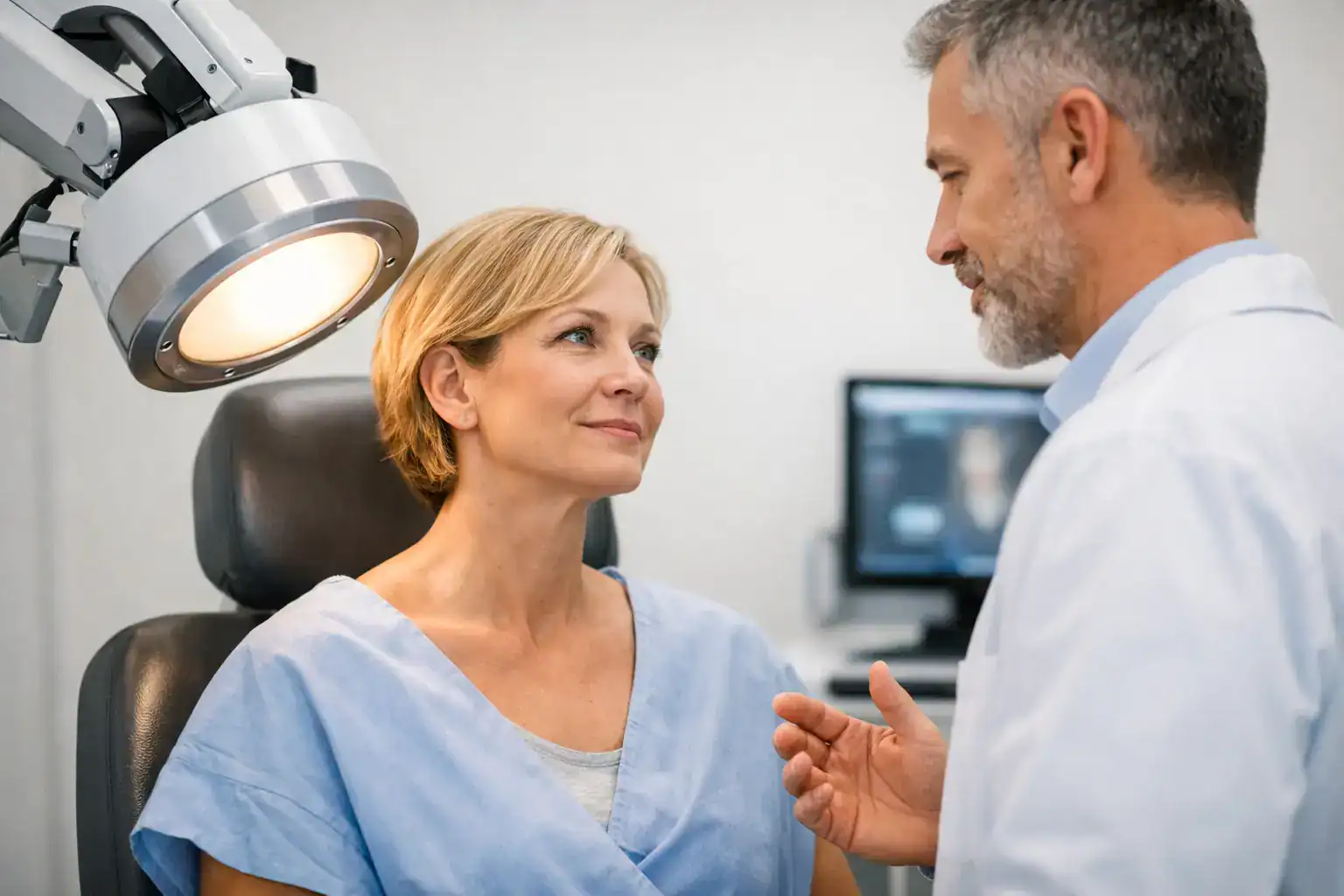
When a skin cancer diagnosis is confirmed, one of the first questions patients ask is simple: do I need surgery? In many cases, surgery is the standard and most effective option. But it is not the only option for every patient, every tumor, or every treatment goal. For certain non-melanoma skin cancers, superficial radiotherapy can be an appropriate, effective, and tissue-sparing treatment.
Superficial radiotherapy for skin cancer uses low-energy radiation to treat cancer cells near the surface of the skin. Because the radiation does not travel deeply, it is designed for cancers that are confined to the skin and nearby superficial tissue. This approach has been used for many years and remains a valuable option in dermatology, especially for patients who are not ideal surgical candidates or who want to avoid an incision in a cosmetically sensitive area.
What superficial radiotherapy treats
Superficial radiotherapy is most often considered for certain basal cell carcinomas and squamous cell carcinomas. These are the two most common forms of non-melanoma skin cancer. The treatment is generally not used for melanoma, which behaves differently and usually requires a different treatment plan.
Whether superficial radiotherapy is appropriate depends on several factors, including the exact diagnosis, the size and depth of the tumor, its location, whether it is a first-time cancer or a recurrence, and the patient’s overall health. A small skin cancer on the face may be approached differently than one on the trunk or lower leg. A patient taking blood thinners, dealing with healing challenges, or unable to undergo surgery may also have a different set of considerations.
That is why treatment selection should start with a thorough skin cancer evaluation, not a one-size-fits-all recommendation.
How superficial radiotherapy for skin cancer works
Superficial radiotherapy for skin cancer delivers targeted radiation to the affected area in carefully measured doses over a series of visits. The goal is to damage the cancer cells so they can no longer grow and divide, while limiting exposure to deeper healthy tissue.
Treatment is typically performed in the office and does not require general anesthesia. Each session is relatively short, but the full course usually involves multiple appointments over several weeks. The exact schedule depends on the type of cancer, the location, and the total dose being prescribed.
Patients often appreciate that the treatment itself is noninvasive. There is no scalpel, no stitches, and no surgical wound to care for afterward. That said, noninvasive does not mean casual. Radiation treatment still requires planning, consistency, and follow-up to make sure the skin is responding as expected.
When it may be a good option
Superficial radiotherapy can be a strong option for patients in specific situations. It may be recommended for older adults, patients with medical conditions that make surgery more difficult, or those who have skin cancers in areas where surgery could be more complex from a cosmetic or functional standpoint, such as the nose, eyelid, ear, or lip.
It may also be considered when a patient has understandable concerns about surgery, scarring, or wound healing. For some people, avoiding a surgical procedure is the deciding factor. For others, the better fit comes from balancing effectiveness with comfort, recovery, and personal preference.
Still, the right fit depends on the details. If a tumor is aggressive, poorly defined, deeply invasive, or recurrent, surgery or Mohs micrographic surgery may offer better margin control. In those cases, the ability to remove tissue and confirm that the cancer is fully cleared can be a major advantage.
How it compares with surgery and Mohs
Surgery remains the most common treatment for many skin cancers because it removes the cancer directly and allows the tissue to be examined. Mohs surgery offers the added benefit of checking 100 percent of the surgical margin in real time, which can be especially important for high-risk tumors or cancers in areas where preserving healthy tissue matters.
Superficial radiotherapy works differently. Instead of removing the tumor, it treats it over time with radiation. That can be appealing for patients who want a non-surgical approach, but it also means there is no specimen to examine after treatment in the same way there is with surgery.
This is where trade-offs matter. Radiotherapy avoids an incision and may preserve appearance well in selected cases, but it requires multiple visits and may not be the best choice for every tumor type. Surgery is often completed in a single day, though healing continues afterward. Mohs has very high cure rates for many skin cancers, particularly in high-risk locations, but it is still a surgical procedure.
The best treatment is not the one with the simplest description. It is the one that matches the biology of the cancer and the needs of the patient.
What to expect during treatment
Before treatment begins, the area is evaluated and the treatment field is carefully planned. During each session, the radiation device is positioned over the skin cancer site to deliver a precise dose to the surface layers of the skin.
Most patients do not feel pain during the treatment itself. Sessions are usually brief, and normal activities can often continue the same day. Because the treatment is spread out over time, patients should be prepared for regular office visits and a schedule that requires consistency.
Skin changes can develop gradually during the course of treatment. The treated area may become pink, red, dry, irritated, or tender. In some cases, the skin can peel or crust before healing. These reactions are expected to some degree and are part of how the skin responds to radiation. Your dermatology team will give instructions for skin care during and after treatment.
Recovery and cosmetic outcome
One reason patients ask about superficial radiotherapy is concern about visible scarring. In carefully selected cases, cosmetic outcomes can be very good. Because there is no incision, there is no surgical scar in the usual sense.
However, the skin may still show changes over time. Depending on the location and the individual response, treated skin can become lighter or darker, thinner, or more visibly textured. Some patients develop long-term redness or small visible blood vessels in the area. These effects are not always significant, but they should be part of the decision-making conversation.
For patients focused on appearance, the question should not be whether one option is scar-free and another is not. The better question is which treatment is most likely to control the cancer while producing the best realistic long-term result for that specific site.
Who may need a different approach
Superficial radiotherapy is not ideal for every patient or every skin cancer. Younger patients may be counseled more carefully because radiation effects can evolve over many years. Some tumors are too deep, too aggressive, or too poorly defined for this approach to be the best first choice.
It may also be less appropriate in areas that have already been treated with radiation, or in situations where recurrence would be especially difficult to manage later. If a skin cancer returns after radiation, follow-up treatment can become more complicated.
That does not mean radiation is a second-best option. It means it is a specific option, with strengths and limitations, and it works best when those are understood clearly from the start.
Why expert evaluation matters
Skin cancer treatment should account for more than the pathology report. Location, patient age, medical history, healing ability, cosmetic priorities, and recurrence risk all matter. A treatment that sounds convenient on paper may not offer the best long-term control. On the other hand, a patient who is not a strong surgical candidate should still have access to effective alternatives.
That is where a comprehensive dermatology practice can make a difference. Patients benefit when medical dermatology, skin cancer surgery, and advanced treatment options are all available within one system, because recommendations can be tailored rather than forced into a narrow treatment pathway. At Goodman Dermatology, that means evaluating each case individually and helping patients understand not just what can be done, but what makes the most sense.
Questions to ask at your consultation
If superficial radiotherapy has been mentioned as a possible treatment, ask whether your skin cancer is the right type, size, and depth for this approach. Ask how its expected cure rate compares with surgery in your case, what the treatment schedule would look like, and what skin changes are most likely afterward.
It is also reasonable to ask what would happen if the cancer came back, and whether another option would offer better margin control up front. These are practical questions, and a qualified skin cancer specialist should be able to answer them clearly.
For many patients, the right choice is the one that balances cancer control, recovery, convenience, and cosmetic outcome in a way that fits real life. If superficial radiotherapy is part of that conversation, it deserves the same careful attention as any surgical plan – because choosing well at the beginning can make the entire treatment process smoother and more reassuring.