
Skin Cancer Surgical Center
Our skin cancer center is one of the largest in Georgia.
Skin Cancer Treatments
Basal Cell Carcinoma Treatment
This common but serious skin cancer affects the skin’s cycle of producing new skin cells when old skin cells die. When detected early, there are multiple treatment options.
Squamous Cell Carcinoma Treatment
The second most common type of skin cancer, this carcinoma affects the skin cells that make up the outermost layer of the skin. It is most often found on the face, neck and arms.
Melanoma Treatment
This form of skin cancer, which appears on sun-exposed parts of the skin, is the most serious form of skin cancer, but it is easily treated when caught early.
Mohs Surgery
Mohs micrographic surgery is the gold standard for skin cancer removal, offering the highest cure rates and performed by our board-certified and fellowship-trained Mohs surgeons.
Photodynamic Therapy (PDT)
This advanced treatment offered at Goodman combines light energy and topical solutions to treat cancerous and precancerous growths.
Superficial Radiotherapy (SRT)
This non-invasive skin cancer treatment harnesses X-rays to treat cancer without scarring, so it's a popular option, but it can only be used on certain cancers.
Skin Cancer Diagnosis
The timely diagnosis of skin cancer can make a big difference in the treatment process. We use patient education and various diagnostic techniques to catch skin cancer as early as possible.
Skin Cancer Types
Skin cancer can be a serious condition, but when detected and treated early, it can be successfully eliminated with minimal damage to the skin.
Molecular Testing
If you have been diagnosed with melanoma, or are seeking a diagnosis of a skin growth you suspect is malignant, this advanced service can reveal important details about your growth.
Rare Skin Cancers
While there are three main types of skin cancer, there are also rarer skin cancers that require special attention. We specialize in treating these types of skin cancer.
Reconstructive Surgery
When surgery is involved as part skin cancer treatment, it can leave behind significant skin damage, but we can help restore the skin’s appearance.
Scar Revision
Scarring is one of the primary concerns of skin cancer patients. Fortunately, scar revision can help eliminate these concerns and restore healthy looking skin.
Skin Repairs
Although skin cancer treatment can leave behind skin damage, repair treatments can restore the skin’s appearance and help a patient feel more like themselves.
Topical Treatments
For patients with mild cases of skin cancer or in cases where skin cancer has been detected early, topical treatments may be an option. Your provider will walk you through your options.
How does a dermatologist evaluate or diagnose skin cancer?
Your dermatologist will biopsy lesions before confirming diagnosis. Treatment is initiated after Goodman Dermatology confirms the diagnosis. There are a wide variety of treatments available to patients suffering from epidermal cancers, including topical treatments, chemotherapy or immunomodulator medications. Some epidermal cancers require surgical excision; others can be removed with laser therapies.
The Skin Cancer Foundation reports that early identification and treatment are important to successful treatment. About 85% of patients with these cancers will recover with the benefit of physician’s care.
To learn more about skin cancer treatment or schedule your appointment at our Skin Cancer Surgical Center, contact us today. We serve the north metro Atlanta and North Georgia areas and many surrounding cities.
Skin Cancer FAQs
Cancer occurs when the body’s cells cease to grow in an organized and normal fashion. When cancer cells are present, it’s possible for them to spread from one part of the body to another through the blood, lymph, or nervous system. This process is known as metastasis. Goodman Dermatology offers medical, surgical, and cosmetic therapies for patients with cancers of the skin.
Skin cancer may include basal cell carcinoma, the most commonly diagnosed form; squamous cell carcinoma; or melanoma. Each of these cancers has different symptoms, and treatment options differ for each type.
In every case, the patient is evaluated, diagnosed, and provided with appropriate next steps for treatment.
Skin cancer is quite preventable. Patients who avoid harmful ultraviolet light (UVA and UVB rays) can help to keep their skin healthy. The sun is the primary source of this kind of radiation, but some patients use dangerous tanning salons or tanning beds. The American Cancer Society strongly discourages the use of tanning machines because they’re known to promote cancer.
It’s important for patients to protect their skin with clothes and sunscreen when they spend time in the sun. Sunburns, especially those suffered in the patient’s early life, have been shown to increase the potential to develop skin cancer later on.
Light or fair skin and Caucasian race is another risk factor for skin cancer. Melanin, a pigment present in all skin, helps to protect the patient’s skin from UV damage. Darker skinned patients have more melanin present, so they’re at lower risk for the development of epidermal cancer. Of course, lower risk doesn’t mean no risk, so all patients should use sunscreen and wear protective clothes when enjoying the sun.
Other risk factors for skin cancer include:
- Prior incidence of skin cancer
- Genetic likelihood (family history) of skin cancer
- Radiation treatment for any other form of cancer
- Psoriasis treatments using special UV lights
- Environmental proximity of the body to certain chemicals, including petroleum, arsenic, or tar
- Poor immune function
- Smoking cigarettes
- Scarring from prior skin infections or burns
- Other skin disease, such as basal cell nevus syndrome or xeroderma pigmentosum
- Abnormal moles
- Human papilloma virus (HPV) infections; and more.
Skin cancer treatments are any techniques involved in the process of treating and curing skin cancer. Since skin cancer typically only affects the epidermis and does not travel deeper into the skin, many skin cancer treatments are mild in nature. While some patients may require treatment that involves surgical techniques, there are many non-invasive and minimally invasive solutions for patients who have detected skin cancer early on. Success rates are quite high for skin cancer treatment, which is why full-body skin exams and other smart skin care habits are so important.
Goodman Dermatology is home to some of the region’s most experienced and respected doctors and team members. With our diverse staff, we are able to provide a range of treatments and services at the highest level of care. This includes Mohs surgery as well as many other advanced skin cancer treatments. With this expertise, we are proud to offer skin cancer treatment for a variety of skin cancer types.
Dr. Josh Hammel and Dr. Nedyalko Ivanov are board-certified dermatologists whose primary focus of practice is Mohs micrographic surgery as well as reconstructive and cosmetic surgery. Both are board-certified dermatologists and fellowship-trained Mohs surgeons.
If you choose Goodman Dermatology’s skin cancer surgical center for skin cancer treatment, you can expect professional, yet personalized care. We are determined to help you achieve the best results possible by providing customized treatments. And, with multiple locations, you’re sure to find a convenient location for your visit.
The American Cancer Society reports that skin cancer diagnoses continue to increase each year. About 1 million residents of the United States are told they have at least one form of skin cancer. It’s possible for a patient to have all three types of skin cancer present. These serious conditions require treatment. Dr. Marcus B. Goodman evaluates, diagnoses, and treats patients with skin cancer and all types of human skin disease or condition.
Basal Cell Carcinoma is the most frequently diagnosed form of skin cancer. About 75-80% of all skin cancer diagnoses are this form. These lesions present in the skin’s top layer, frequently on the neck, hands, and face where skin has been exposed to damaging UV rays of the sun. This type of skin cancer is often the most treatable because it’s least likely to spread from one part of the body to another.
Any skin cancer can spread, however, and even basal cell carcinoma can cause the sufferer to feel disfigured. It’s possible to lose fingers, eyes, nose, or even ears as a result of the growth of this cancer type. Patients should report any lesion that bleeds or oozes; turns red quite suddenly; or looks a bit like a scar (a bump may or may not be present). These lesions can be skin cancer. Learn more about basal cell carcinoma.
Squamous Cell Carcinoma is diagnosed in about 20% of epidermal cancer cases. Men develop squamous cell carcinoma about twice as often as women. American Cancer Society says that almost 300,000 cases of this type of cancer are diagnosed each year, and that the number of cases are rising. Patients usually get this form of epidermal cancer on the face, hands, neck, lips, or ears. Sometimes, the lesion becomes an open sore that won’t heal. Other times, it’s red or flat, develops scales or has a crusty appearance. In other instances, a raised bump appears and continues to grow. Squamous cell carcinoma has the potential to spread from one location to the patient’s bones and organs. These tumors are usually small and thin at first, and most are successfully treated if identified early. About one percent of those diagnosed with squamous cell carcinoma die from the disease. Learn more about squamous cell carcinoma.
Melanoma is a less common but more aggressive form of skin cancer that develops in melanocytes, the cells responsible for skin pigment. It is often found on the back, legs, arms, or face, and may appear as a new mole or a change in an existing mole. These lesions can have irregular borders, multiple colors, or an asymmetrical shape. Melanoma has a higher risk of spreading to other parts of the body if not identified early. However, when detected and treated in its earliest stages, melanoma is highly treatable. Learn more about melanoma.
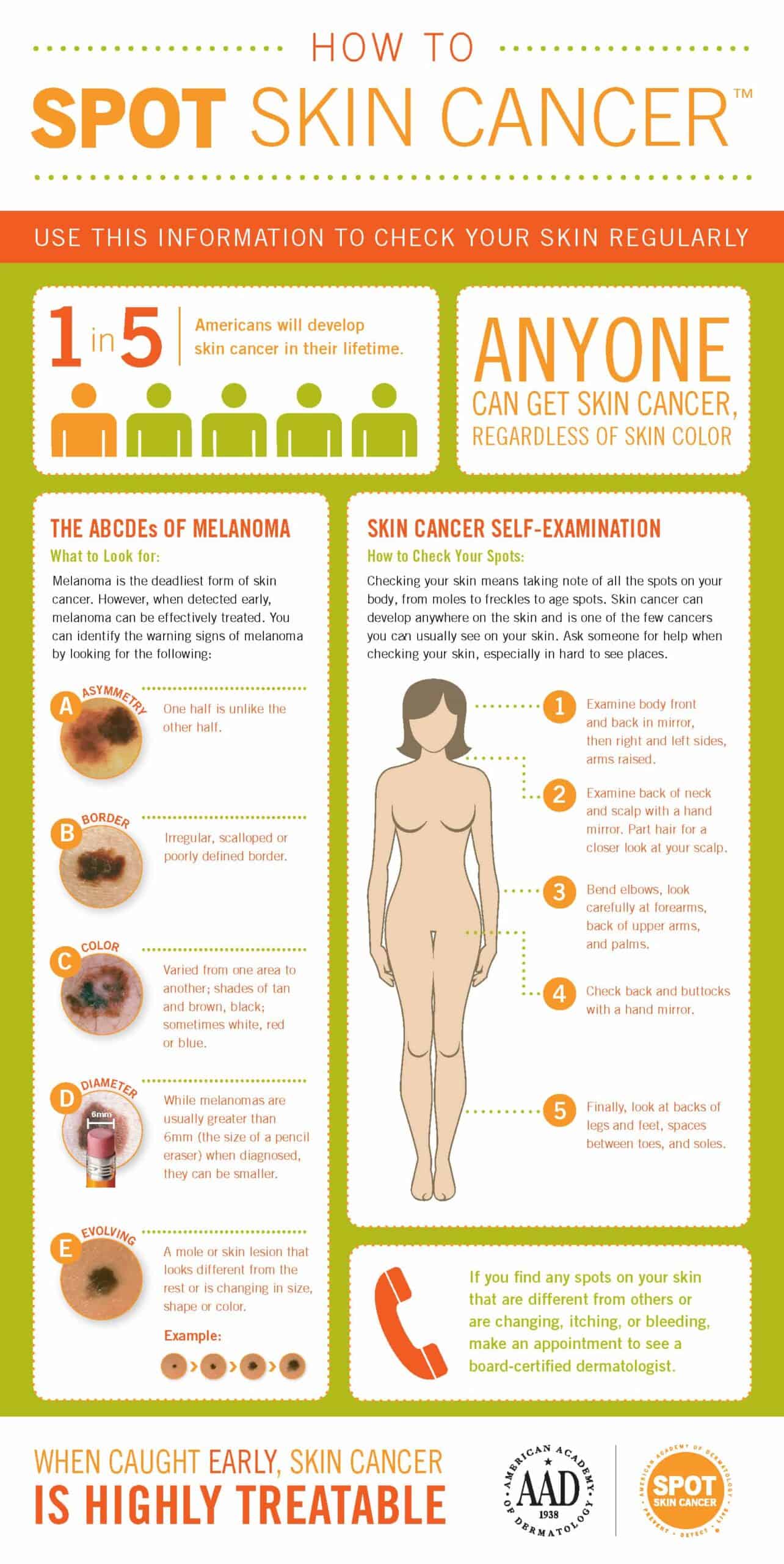
Abnormal moles are moles that can become cancer. Researchers from Johns Hopkins University cite the ABCD acronym for identifying moles that can be abnormal or cancerous.
Consider these indicators:
- Asymmetry: An uneven shape can help the patient and physician identify an early problem. Not all asymmetrical moles are cancer, but it’s important to perform self-checks and report any concerns to the doctor.
- Border: An uneven, feathered, notched, or wavy border around any mole should be checked.
- Color: The mole’s color can be an early warning symptom. Most moles are a single color. When a mole is partially two or more colors, it’s time to call the dermatologist. Some unusual colors, including blue, white, or black, may be early warning symptoms of a serious skin cancer called melanoma.
- Diameter: The mole’s width can also help to identify a problem. If the mole is bigger than the size of a pencil eraser (about 6 mm), it’s time to check in with your dermatologist.
- Evolution: Any mole that changes should be checked. When an existing mole grows quickly or appears and then grows quickly, contact Goodman Dermatology. Learn more about abnormal moles and mole removal.