
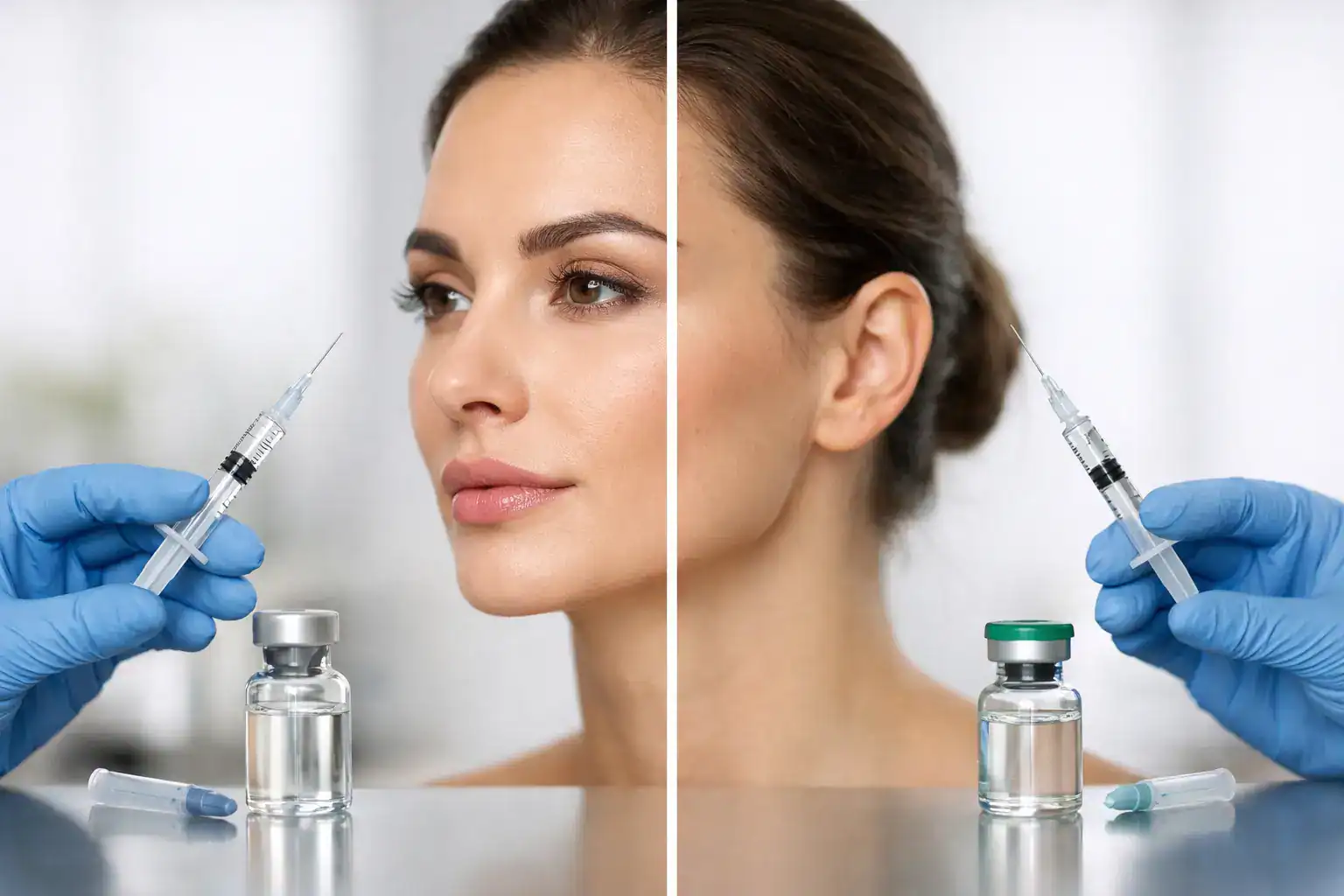
Choosing between Botox vs Dysport usually starts with a simple question: will one give me better results than the other? For most patients, the answer is not that one is universally better. It is that the best choice depends on your anatomy, your treatment area, how quickly you want to see results, and how you respond to injectable neuromodulators over time.
Both Botox and Dysport are FDA-approved prescription injectables used to soften dynamic wrinkles – the lines caused by repeated facial movement. That includes frown lines between the brows, forehead lines, and crow’s feet. In experienced hands, both can create smoother skin while preserving natural expression. The real difference is in how they are formulated, how they diffuse, and how your treatment plan is customized.
Botox vs Dysport: What they have in common
Botox and Dysport are both botulinum toxin type A products. They work by temporarily relaxing targeted muscles that create expression lines. When those muscles move less forcefully, the overlying skin appears smoother and more rested.
For patients, the experience is often very similar. Treatments are performed in the office, usually take only a short time, and require little to no downtime. Results are temporary, so maintenance treatments are needed to keep lines softened. Both products can also be used strategically for preventive treatment in younger adults and for established lines in patients who want a refreshed appearance without surgery.
Safety profiles are also comparable when treatment is performed by a qualified medical professional. Precise injection technique matters. Product selection is only one part of the equation. The anatomy of your muscles, the depth of your lines, and the injector’s judgment all play a major role in the final outcome.
Key differences in Botox vs Dysport
The most common question patients ask is whether Botox and Dysport are the same thing. They are similar, but not identical.
Dysport tends to spread a bit more after injection. That can be an advantage in larger treatment areas, such as the forehead, where broader distribution may help create a smooth result. Botox may offer a slightly more contained effect in smaller or more targeted areas. Neither characteristic is automatically better. It depends on the area being treated and the look you want.
Some patients also notice that Dysport begins working a little sooner, sometimes within a few days, while Botox may take a bit longer to fully appear. That said, individual response varies. If you have an upcoming event, timing your treatment matters more than assuming one product will always act faster.
Dosing is different as well. Botox units and Dysport units are not interchangeable. A treatment plan using Dysport will often involve a higher number of units on paper, but that does not mean it is stronger or that you are getting more product in a meaningful clinical sense. It simply reflects a different unit measurement.
Duration can be similar for both, often around three to four months, though some patients feel one lasts a little longer for them personally. Metabolism, muscle strength, treatment area, and consistency of follow-up all affect longevity.
Does one look more natural?
A natural result is much more about injection technique than brand name. Both Botox and Dysport can look subtle and refined when the dose, placement, and goals are matched carefully to the patient.
Problems usually happen when treatment is too aggressive, poorly placed, or based on a one-size-fits-all approach. A patient with strong glabellar muscles may need a different strategy than someone treating early fine lines. Likewise, treating a forehead without balancing the brow area can affect expression no matter which product is used.
If your goal is to look less tired, less tense, or more polished without looking frozen, that should be part of the conversation before treatment starts.
Which areas are commonly treated?
When comparing Botox vs Dysport, most patients are thinking about cosmetic treatment for upper-face lines. The most common areas include the vertical lines between the brows, horizontal forehead lines, and crow’s feet at the outer corners of the eyes.
In some cases, neuromodulators are also used for other concerns such as chin dimpling, a gummy smile, jawline slimming, platysmal neck bands, or excessive underarm sweating. Not every product is used the same way in every area, and treatment should always be guided by a medical evaluation.
For someone bothered mainly by deep frown lines, either Botox or Dysport may be an appropriate option. For a patient who wants broader forehead softening, Dysport’s diffusion pattern may be helpful. For very precise correction in a smaller area, Botox may sometimes be preferred. The right answer is often specific to your face rather than the product alone.
Botox vs Dysport for first-time patients
If this is your first neuromodulator treatment, it helps to think beyond the brand comparison. Start with your goals. Are you hoping to prevent lines from setting in? Soften lines that are already visible at rest? Maintain movement while reducing a tense or tired appearance? Those details shape the plan.
First-time patients often do best with a conservative approach. It is easier to add a small amount later than to reverse an overtreated look. This is especially true for the forehead, where balance is important for brow position and facial expression.
Your medical history also matters. Prior treatment with neuromodulators, pregnancy or breastfeeding status, certain neuromuscular conditions, allergies, and current medications should all be reviewed before treatment. A proper consultation is not just about where to place injections. It is about making sure treatment is appropriate and safe.
What about cost?
Cost comparisons can be confusing because Botox and Dysport are priced differently per unit, and the units are not equivalent. Looking only at the price per unit does not tell you what your total treatment cost will be.
A more useful question is what it will take to treat your specific concern effectively. A lower unit price may still lead to a similar total if more units are needed. This is one reason transparent consultation and individualized planning matter. The goal should be value and outcome, not just the lowest advertised number.
How to decide between Botox and Dysport
The most practical way to choose between Botox vs Dysport is to let the decision come from a facial assessment rather than marketing. An experienced dermatology provider will evaluate your muscle movement, symmetry, line depth, brow position, and desired level of correction.
In some patients, Botox may be the better fit because of the treatment area or the injector’s precision goals. In others, Dysport may be a strong choice because of how it spreads or how the patient has responded in the past. If you have had one product before, your prior experience is useful information. If you liked the timing, feel, and longevity, that may support staying consistent. If your result was underwhelming, it may be worth adjusting technique, dose, or product.
Patients in North Georgia often want the same thing: a treatment that works, fits into a busy schedule, and does not leave them looking obviously treated. That is where a dermatology practice with both cosmetic expertise and a strong medical foundation can be especially helpful. At Goodman Dermatology, treatment planning is centered on facial anatomy, safety, and natural-looking results rather than a one-brand-fits-all approach.
Questions worth asking at your consultation
A good consultation should make the choice clearer. Ask which product is being recommended for your treatment area and why. Ask how many units are typically used, how soon you may see results, and when a follow-up is appropriate. If you want subtle movement rather than a fully smooth look, say so directly.
It is also reasonable to ask about side effects. Common short-term effects can include mild redness, swelling, tenderness, or bruising at injection sites. Less common risks depend on placement and anatomy. This is why proper technique and a medically trained injector are so important.
The strongest predictor of a good outcome is not whether you choose Botox or Dysport off a menu. It is whether your treatment is planned thoughtfully, performed precisely, and adjusted over time based on how your face responds.
If you are deciding between the two, think less about which name sounds more familiar and more about which option best matches your features and goals. The right injectable should fit your face, your timeline, and your comfort level – and that decision is best made with expert guidance.