
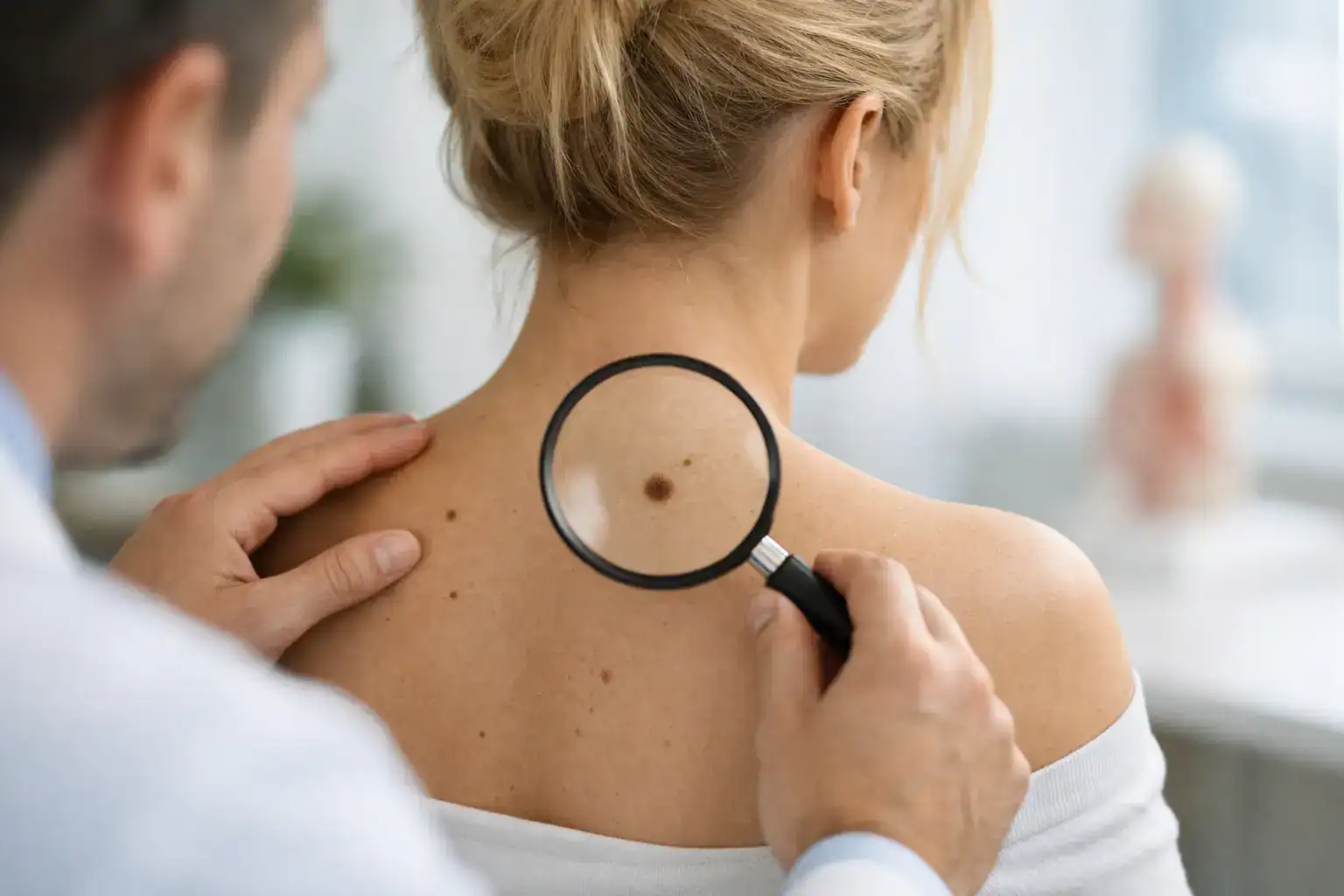
Most people have at least a few moles, and most of them are harmless. The real question is when should moles be checked, especially if one looks a little darker, feels different, or seems to have changed over time. For patients, the right answer is not to panic – but not to ignore it either.
Moles are common growths made up of pigment-producing skin cells. They can appear anywhere on the body and may be flat or raised, smooth or slightly textured, tan, brown, pink, or nearly skin-colored. Some are present from childhood, while others appear later. Because moles are so common, it can be hard to tell what is normal and what deserves attention.
That is where timing matters. A mole does not need to look dramatic to justify an exam. In many cases, the earlier a concerning spot is evaluated, the simpler the next steps can be.
When should moles be checked by a dermatologist?
A mole should be checked if it is new, changing, symptomatic, or noticeably different from your other spots. Many patients wait for pain or bleeding before making an appointment, but skin cancers do not always cause discomfort early on. In fact, some of the most concerning lesions are easy to overlook because they seem subtle.
One of the most useful ways to assess a mole is the ABCDE rule. If you notice asymmetry, uneven borders, multiple colors, a diameter larger than about 6 millimeters, or evolution over time, it is worth having the spot examined. Evolution is often the most important clue. A mole that has changed in size, shape, color, texture, or behavior should not be brushed off as routine.
There is also the “ugly duckling” idea, which can be just as helpful. If one mole looks clearly different from the rest of your moles, even if it does not check every ABCDE box, it deserves attention. Some melanomas do not follow textbook patterns.
A dermatologist should also evaluate a mole if it itches, bleeds, crusts, becomes tender, or does not heal as expected. Those symptoms do not automatically mean skin cancer, but they do mean the lesion needs a closer look.
Changes that matter and changes that may not
Not every mole change is dangerous. Hormonal shifts during adolescence and pregnancy can make some moles darken slightly. Friction from clothing or shaving can irritate a raised mole. Age can also bring new benign spots that are not moles at all, such as seborrheic keratoses or cherry angiomas.
Still, there is a difference between mild expected variation and meaningful change. A mole that slowly becomes a little more raised over many years may be less concerning than one that changes noticeably over a few months. A spot that gets irritated after shaving once is different from a lesion that repeatedly bleeds without a clear cause.
This is one reason self-diagnosis has limits. Online images can be misleading, and many benign lesions can resemble skin cancer while some skin cancers look deceptively ordinary. If a mole is raising questions in your mind, an in-person skin exam is usually the most efficient way to get a reliable answer.
When should moles be checked sooner rather than later?
Some situations call for prompt evaluation instead of a wait-and-see approach. If a mole is changing quickly, bleeding on its own, becoming irregular in color, or appearing after adulthood with an unusual look, it should be assessed sooner. Patients with a personal history of skin cancer should also be more cautious with any new or changing lesion.
Family history matters too. If melanoma runs in your family, your threshold for getting a mole checked should be lower. The same is true if you have many moles, atypical moles, fair skin, significant sun damage, or a history of blistering sunburns. These factors do not mean every mole is dangerous, but they do increase the value of regular professional skin checks.
People with darker skin tones are not exempt, either. While melanoma is less common in skin of color, it can still occur, and delays in diagnosis can make treatment more difficult. Any changing mole or unusual pigmented lesion deserves proper evaluation, regardless of skin tone.
How often should moles be checked?
There is no one-size-fits-all schedule. For many adults, an annual skin exam is a practical starting point, especially if they have multiple moles or significant sun exposure. For others, the recommended interval may be shorter or longer depending on their history and risk profile.
Patients with atypical moles, previous skin cancer, strong family history, or immune suppression may need more frequent surveillance. Children and teens can develop moles as part of normal growth, but a pediatric skin check may be appropriate if a mole is unusual, rapidly changing, or concerning to a parent.
At home, monthly self-checks are reasonable for many patients. That does not need to be complicated. What matters most is noticing your baseline so you can recognize change. Good lighting and a mirror help, and it is smart to check easy-to-miss areas such as the scalp, back, soles of the feet, and between the toes. If a partner or family member can help with hard-to-see areas, even better.
What happens during a mole check?
A professional mole evaluation is usually straightforward. A dermatologist reviews the lesion, asks about change over time, symptoms, and risk factors, and examines the spot closely. In many cases, a dermatoscope is used to magnify and assess pigment patterns and structures not visible to the naked eye.
Sometimes the mole is clearly benign and only needs monitoring. Sometimes the recommendation is to photograph it and recheck it later, especially if the findings are not overtly worrisome but not entirely routine. And sometimes a biopsy is the right next step.
A biopsy does not mean the worst-case scenario. It means the lesion needs a definitive diagnosis. When a spot is suspicious, getting tissue confirmation is often the safest and most efficient path forward.
Why early evaluation makes a difference
The reason dermatologists encourage early assessment is simple. If a lesion is skin cancer, early detection can significantly affect treatment options and outcomes. Melanoma, in particular, can become more serious as it grows deeper into the skin, while many early skin cancers can be treated more simply when found promptly.
There is also peace of mind in getting clarity. Many patients spend weeks watching a mole, comparing photos, and wondering whether they are overreacting. A timely exam can replace uncertainty with a plan, whether that means reassurance, short-term monitoring, or treatment.
For busy families and professionals, this matters. Delaying care often happens because people assume they should wait for a bigger change, or because they are trying to fit the issue into an already full schedule. But skin checks are part of preventive care, not an unnecessary extra.
Common reasons patients wait too long
One of the biggest misconceptions is that a dangerous mole has to be dark black, large, or obviously ugly. Some concerning lesions are pink, small, or only subtly irregular. Another common mistake is assuming that a stable mole can never become a problem. While many harmless moles stay unchanged for years, any new evolution deserves attention.
Patients also sometimes avoid evaluation because they worry every unusual mole will lead to a painful procedure or alarming diagnosis. In reality, many checked moles are benign. When a biopsy is needed, it is often quick and performed in the office with local numbing.
There is a practical side to this as well. Access to dermatology care can make a difference in whether patients follow through. In a large service area like North Georgia, having convenient office locations and appointment availability can make it easier to get a changing spot evaluated before it becomes a bigger issue.
A practical way to decide
If you are unsure whether a mole needs attention, ask yourself a few simple questions. Is it changing? Is it acting differently from your other moles? Is it itching, bleeding, crusting, or not healing? Do you have risk factors that make closer surveillance more important? If the answer to any of those is yes, scheduling a skin check is a smart next step.
You do not need to be certain that something is wrong before seeing a dermatologist. That is the point of the evaluation. Patients are not expected to diagnose melanoma at home. They just need to recognize when a spot no longer feels routine.
Skin cancer screening is most effective when it is proactive rather than reactive. If a mole has caught your attention for any reason, trust that instinct and have it examined. A brief visit now can be far easier than dealing with a problem that was left to declare itself later.