
Dermoscopy
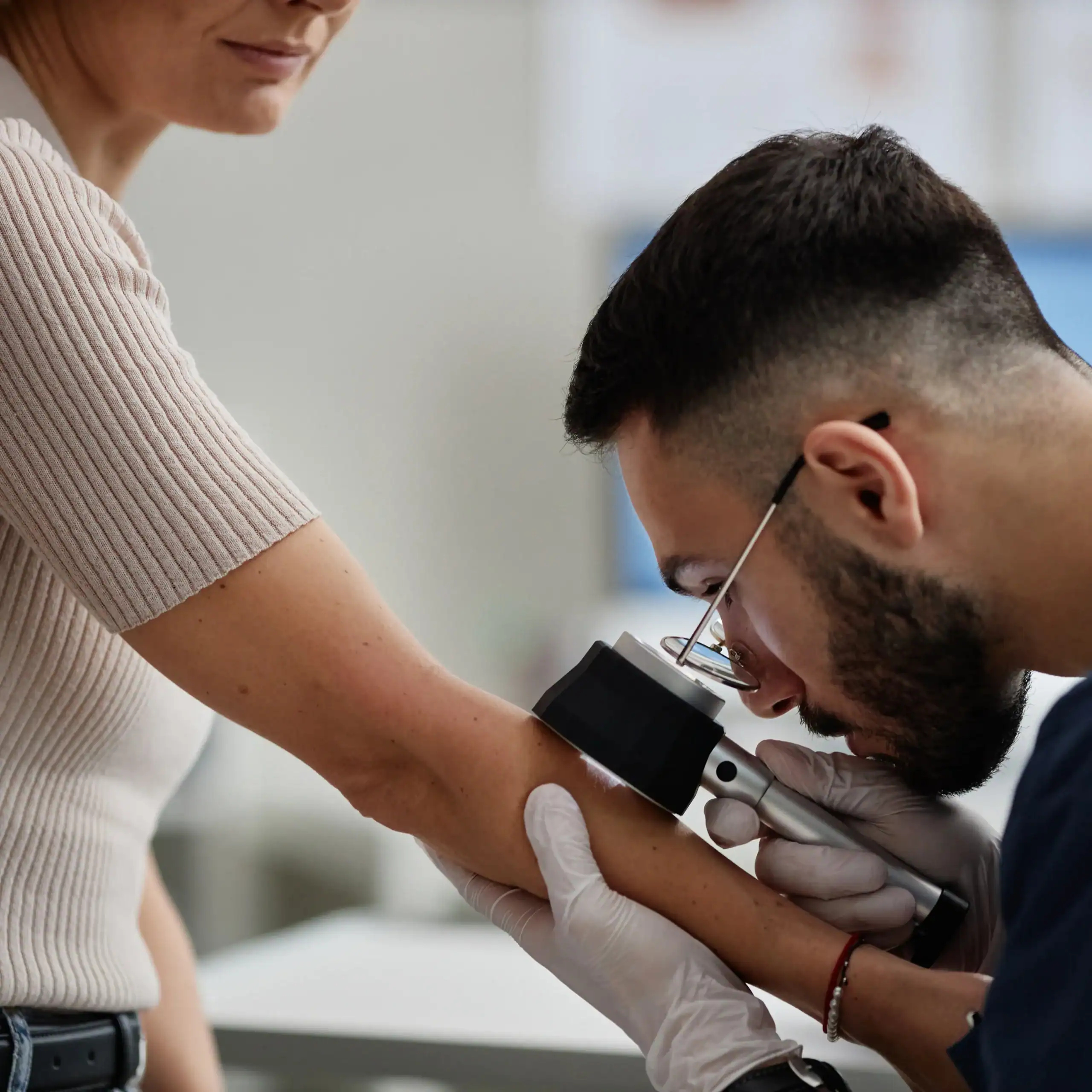
At Goodman, we use a dermatoscope to magnify the surface and deeper layers of the skin to assess pigmented lesions in the skin, including moles and other skin growths.
What Is Dermoscopy?
Dermoscopy is a diagnostic technique that is used to evaluate the skin’s surface and deeper layers. Dermoscopy is a non-invasive method, meaning it is quickly and easily performed and is painless for the patient. The technique typically involves the use of a handheld instrument called a dermatoscope or surface microscope to visualize microscopic skin structures in the epidermis and dermis.
At Goodman Dermatology, we use the dermoscopy technique to assess pigmented lesions in the skin. This includes moles and other skin growths to determine if a mole is benign or a growth is normal. Dermascopy is especially helpful in helping diagnose if a growth is cancerous or may become cancerous in the future.
Dermoscopy FAQs
Dermascopy is performed using a simple handheld tool, similar in function to a magnifying glass. By looking at the skin closely, we can observe the qualities of the skin and the pigmented lesion in question. During the dermoscopy process, we are looking for any qualities that suggest we are dealing with an atypical mole. Most moles are healthy, natural growths and pose no risk. These are typically brown, pink, or flesh-colored, and round and regular in shape.
Atypical moles have different qualities. They are larger, and often have a dark or irregular pigmentation and poorly defined borders. A moles with these features is called a dysplastic nevus. It has been observed that a dysplastic nevus can become melanoma, which is a very serious form of skin cancer. Patients who repeatedly develop dysplastic nevi may also be at higher risk of developing melanoma. Dermoscopy enables us to detect any suspicious growths in order to address them before they become more dangerous.
If there are no suspicious growths discovered during your dermoscopy, then no further treatment is required.
If we discover a dysplastic nevus during the examination, we will perform a biopsy to confirm the diagnosis. A biopsy involves the removal of skin cells from the pigmented lesion. These skin cells will be examined under a microscope in order to determine the final diagnosis. A dysplastic nevus is diagnosed based on the severity of the growth.
- Mildly dysplastic nevus: This is the most common form of dysplastic nevus. It poses no immediate threat, so additional treatment is seldom necessary. However, growths should be watched in case any changes or additional growth develops in the future.
- Moderately dysplastic nevus: With this diagnosis, removal via excision is often recommended. In some cases, patients may just need to continue observing the area.
- Severely dysplastic nevus: This condition is difficult to differentiate from melanoma. For this reason, surgical excision is almost always recommended.
Any growths that require removal are removed with surgical excision techniques. In most cases, this involves the removal of the pigmented lesion with an extra 2-3mm of surrounding skin. In severe cases, we may remove up to 5mm of surrounding skin to ensure complete removal of the growth.
Your doctor will be able to inform you when dermoscopy and other diagnostic tools become necessary. The main purpose of this technique is to detect melanomas and other serious skin conditions as early as possible. Fortunately, there are also many ways for patients to do this on their own without the use of dermoscopy. Patients are encouraged to receive annual full-body skin exams in order to check the skin for growths on a regular basis. If you develop a new growth, or observe unusual changes in a current mole, you may want to visit your dermatologist for a closer examination.
If you have noticed unusual growth of pigmented lesions, contact us today to schedule your initial consultation at Goodman Dermatology. We’ll use dermoscopy and other effective diagnostic techniques to examine the skin and keep you healthy. We welcome patients from north metro Atlanta and North Georgia and surrounding cities.