
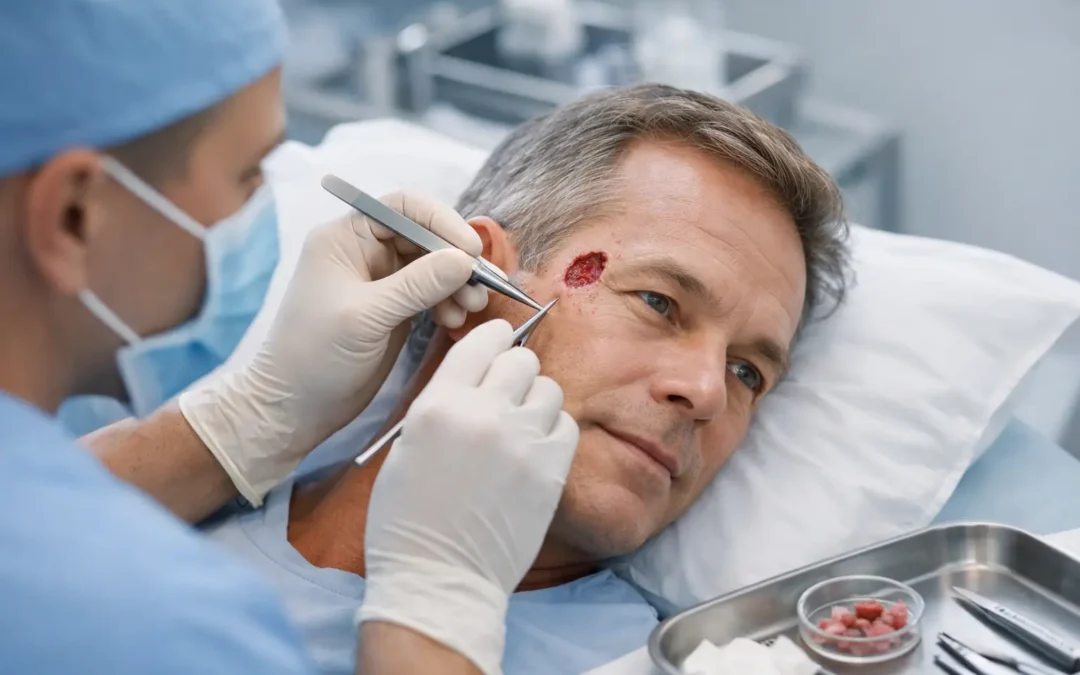
A skin cancer diagnosis often raises two immediate questions: Will it be fully removed, and what will the area look like afterward? For many patients, Mohs surgery addresses both concerns with a level of precision that standard excision cannot always match.
Mohs micrographic surgery is a specialized procedure used to treat certain skin cancers by removing thin layers of tissue one stage at a time and examining each layer under a microscope right away. Instead of removing a wider margin all at once and waiting days for pathology results, the surgeon maps and checks the tissue during the visit. This process continues until no cancer cells remain.
That real-time tissue analysis is what makes Mohs surgery different. It allows the surgeon to remove as little healthy skin as possible while still achieving very high cure rates. For cancers on the face, ears, scalp, hands, shins, or other areas where preserving tissue matters, that advantage can be significant.
When mohs surgery for skin cancer is recommended
Mohs surgery is not used for every skin cancer. It is most often recommended when the cancer has a higher risk of recurrence, has poorly defined borders, is located in a cosmetically or functionally sensitive area, or has returned after prior treatment. It is also commonly used for larger tumors and certain aggressive subtypes.
The skin cancers most often treated with Mohs are basal cell carcinoma and squamous cell carcinoma. In select cases, it may also be used for melanoma in situ or other uncommon tumors, depending on the diagnosis, the location, and the pathology findings. The right approach depends on more than the cancer name alone. Size, depth, growth pattern, previous treatment, overall health, and the body site all matter.
This is why an in-person evaluation is important. Two skin cancers that sound similar on paper may need very different treatment plans. One may be appropriate for standard excision, topical therapy, or electrodesiccation and curettage, while another is better managed with Mohs because of its location or risk profile.
How Mohs surgery works
On the day of the procedure, the area is numbed with local anesthetic. The visible tumor is removed along with a very small margin of surrounding tissue. That tissue is carefully oriented, color-coded, and mapped so the surgeon knows exactly where each piece came from.
The tissue is then processed and examined microscopically. If cancer cells are seen at the edge in a specific area, the surgeon goes back only to that exact spot and removes another thin layer. This staged process repeats until the margins are clear.
Because every edge is checked, Mohs offers a high degree of accuracy. It is designed to spare healthy tissue while thoroughly tracking any microscopic extensions of the tumor. Some skin cancers send out roots or irregular projections that are not visible on the surface. Mohs is particularly useful in finding and removing those extensions.
Once the cancer is fully removed, the surgeon determines the best way to manage the wound. In some cases, the area can heal well on its own. In others, a layered closure, skin flap, or skin graft may provide the best functional and cosmetic outcome. The repair plan depends on the size and location of the surgical site, skin laxity, and each patient’s medical needs.
What to expect at your appointment
Mohs surgery is typically performed in an outpatient setting, and most patients go home the same day. You should expect to be at the office for several hours because the procedure includes periods of waiting while tissue is processed and reviewed.
That waiting time is normal and is part of the reason Mohs is so thorough. The surgical portion itself may be relatively brief, but the lab analysis between stages takes time. Some patients need only one stage. Others need two or more. There is no way to know the exact number before the procedure begins.
Comfort is a common concern, but most patients tolerate Mohs very well with local anesthesia. You may feel pressure or movement, but the area should be numb during the procedure. Mild soreness, swelling, or tightness afterward is expected, especially if the repair is larger or in a high-motion area.
Before your appointment, your care team may review medications, bleeding risk, allergies, and any special medical considerations. After surgery, you will receive wound care instructions tailored to the repair. Following those instructions closely can make a meaningful difference in healing.
Benefits of mohs surgery for skin cancer
The strongest reason many physicians recommend Mohs is its combination of precision and cure rates. By examining 100 percent of the surgical margin in stages, Mohs can detect residual cancer that may be missed when tissue is sampled in a more limited way.
For patients, that translates into several practical benefits. First, there is a high likelihood of complete removal during the visit. Second, preserving more healthy tissue can support better healing and a smaller final wound than a wider excision might require. Third, immediate margin assessment can reduce uncertainty because you are not waiting days to learn whether more treatment is needed.
That said, Mohs is not automatically the best option for every case. It is a highly specialized procedure that is most valuable when the cancer type, risk level, or location makes tissue preservation and complete margin control especially important. If a tumor is low risk and located on an area where standard margins are appropriate, another treatment may be equally effective and more straightforward.
Recovery and healing after surgery
Recovery depends on the size of the defect, the repair method, and the location on the body. A small site may heal quickly with minimal downtime, while a larger repair on the nose, lip, eyelid, ear, or lower leg may require closer follow-up and a longer healing period.
Most patients can resume many normal activities within a day or two, but strenuous exercise, heavy lifting, and activities that increase blood flow to the area may need to be limited for a period of time. Your surgeon will give specific guidance based on the repair.
Swelling and bruising are especially common around the eyes and forehead. This can look dramatic for a few days even when healing is progressing normally. Infections and bleeding are not common, but they can occur, so it is important to know when to call your physician.
Scars are a realistic part of any skin cancer surgery, but careful planning and reconstruction can often produce very favorable results over time. Scar appearance usually improves gradually over several months. Protecting the area from sun exposure and attending follow-up visits can help support the best outcome.
Questions patients often ask before choosing Mohs
Many patients want to know whether Mohs means their skin cancer is more serious. Not necessarily. Mohs is often chosen because of where the cancer is, how it behaves under the microscope, or whether it has been treated before. A small skin cancer on the nose may be a better Mohs candidate than a larger one on the trunk.
Another common question is whether the procedure is covered by insurance. In many cases, Mohs is covered when it is medically indicated, but benefits vary by plan. It is reasonable to ask about coverage, pathology, repair, and follow-up so there are no surprises.
Patients also ask whether one surgery solves the problem permanently. Mohs has excellent cure rates, but having one skin cancer increases your risk of developing another in the future. Ongoing skin checks remain important, even after successful treatment.
Choosing the right team for treatment
Mohs surgery is a specialized technique that depends on training, surgical judgment, pathology interpretation, and thoughtful reconstruction. That is why the experience of the physician and the support of a dedicated surgical team matter.
For patients in North Georgia, access and continuity of care matter too. A practice that can diagnose suspicious lesions, confirm the pathology, perform advanced skin cancer treatment, and continue long-term surveillance can make the process more efficient and less stressful. Goodman Dermatology provides that integrated approach through comprehensive dermatology and a dedicated skin cancer surgical center.
If you have been told you need Mohs surgery, the next step is not to panic. It is to understand why it was recommended for your specific diagnosis, what the treatment day will involve, and how your care team plans for both cancer clearance and healing. Clear answers, expert treatment, and close follow-up can make a difficult diagnosis feel much more manageable.