
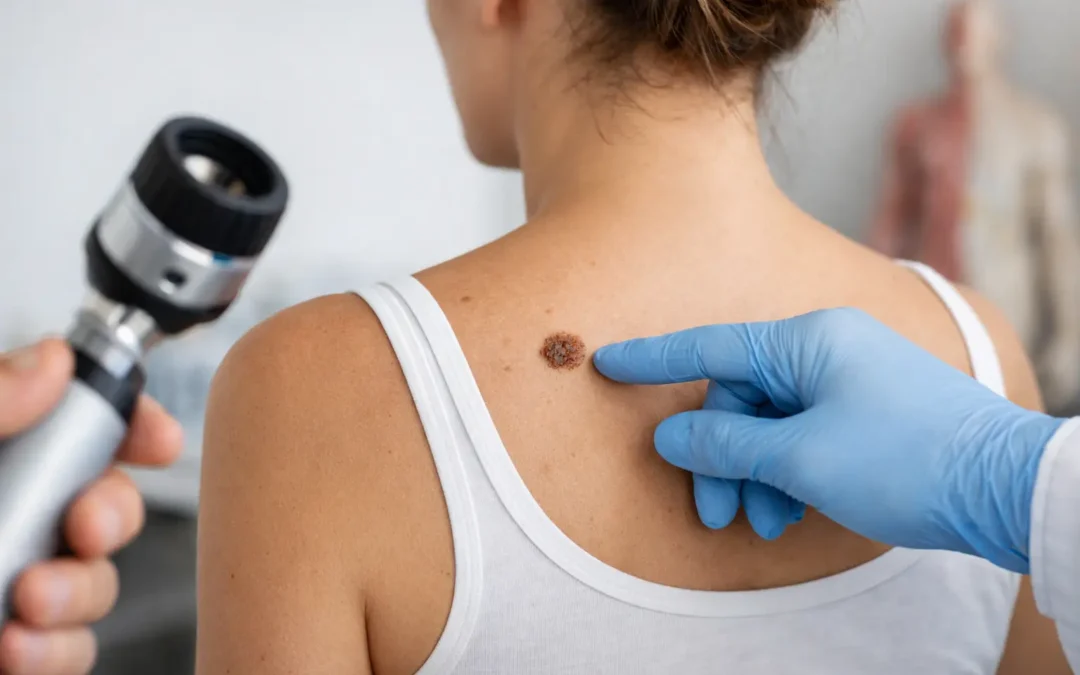
A mole that looked the same for years and then starts changing deserves attention. Many mole changes warning signs are subtle at first, which is why patients often second-guess what they are seeing. A spot may darken, become uneven, itch more often, or simply look different from the rest of your moles. Those changes do not always mean skin cancer, but they do mean it is time for a closer look.
For most people, the right response is not panic. It is prompt evaluation. Skin cancer is highly treatable when found early, and a full-body skin exam can help distinguish a harmless mole from one that needs further testing or removal.
Why changing moles matter
Moles are common, and most are benign. They can be flat or raised, light brown or dark brown, and some people naturally have dozens of them. It is also normal for moles to appear during childhood and early adulthood. What matters most is whether a spot is stable or evolving.
A changing mole may signal melanoma, the most serious type of skin cancer, but it can also point to other forms of skin cancer or a noncancerous growth that still needs evaluation. The challenge is that dangerous lesions do not always look dramatic in the beginning. In many cases, the earliest clue is simply that one mole no longer matches your usual pattern.
That is why dermatologists pay close attention to change over time. A spot that is new, growing, or behaving differently than it did a few months ago deserves more attention than a mole that has looked the same for years.
Mole changes warning signs you should not ignore
The best-known way to assess a mole is the ABCDE rule. It is useful, but it is not the whole picture.
Asymmetry, border, color, diameter, and evolution
Asymmetry means one half of the mole does not match the other. Border refers to edges that look irregular, blurred, scalloped, or poorly defined. Color becomes concerning when a mole has multiple shades, such as tan, brown, black, red, white, or blue within the same lesion. Diameter matters because larger lesions can raise suspicion, especially if they are bigger than about 6 millimeters, though melanomas can be smaller. Evolution may be the most important factor of all. If a spot changes in size, shape, color, texture, or symptoms, it needs evaluation.
Many patients focus on size alone, but small lesions can still be significant. A tiny spot that is clearly changing is often more important than a larger mole that has remained unchanged for years.
The ugly duckling sign
Not every concerning mole fits neatly into the ABCDE pattern. Some stand out because they simply look different from all the others on your body. Dermatologists often call this the ugly duckling sign.
If most of your moles are similar in color and shape, but one spot is darker, pinker, raised differently, or changing faster than the rest, that mole deserves attention. This is especially helpful for people who have many moles and are not sure which one to watch.
Symptoms that may signal a problem
Pain, itching, tenderness, bleeding, crusting, or a sore that does not heal are all worth checking. A mole that becomes irritated after shaving or rubbing against clothing may be harmless, but repeated symptoms still should not be dismissed. Skin cancer can sometimes present as a persistent irritated spot rather than a classic dark mole.
Texture changes also matter. If a mole becomes scaly, develops a rough surface, starts oozing, or feels firmer than before, it should be examined.
When a mole change is less concerning
Not every mole change means cancer. Hormonal shifts, aging, pregnancy, and sun exposure can affect the appearance of pigmented spots. Some benign lesions become raised over time, and others may darken after sun exposure.
Still, there is an important difference between a predictable change and an unexplained one. If you are unsure whether a spot is normal for you, it is better to have it evaluated than to wait and hope it settles down. Dermatology visits are designed for exactly this kind of question.
Who should be especially alert to mole changes warning signs
Anyone can develop skin cancer, including people who do not spend much time outdoors. That said, some patients have higher risk and should be particularly careful about skin changes.
Your risk may be higher if you have fair skin, a history of blistering sunburns, significant cumulative sun exposure, indoor tanning exposure, a personal or family history of melanoma, or a large number of moles. Risk can also increase if you have atypical moles, a weakened immune system, or a previous history of other skin cancers.
Age is a factor, but melanoma is not limited to older adults. It can affect younger adults and, less commonly, even teenagers. That is one reason a new or changing mole should not be brushed off based on age alone.
What to do if you notice a changing mole
Start by paying attention to timing. If you can, note when you first saw the spot and what seems to be changing. A clear photo taken in good lighting can help track growth or color shift over several weeks, especially if the lesion is in a hard-to-see area.
Then schedule a professional skin exam. Waiting several months to see whether a suspicious lesion keeps evolving is usually not the best approach, particularly if the spot is changing quickly, bleeding, or looks distinctly different from your other moles.
During your visit, a dermatologist may examine the lesion visually and with dermoscopy, a specialized tool that provides a more detailed view of pigment patterns and structures within the skin. If the spot appears suspicious, a biopsy may be recommended. That is the only way to confirm a diagnosis.
A biopsy sounds intimidating to some patients, but in most cases it is a straightforward in-office procedure. It also provides clarity, which is often the most valuable part of the process.
Why self-checks help, but should not replace skin exams
Monthly skin self-checks can be useful, especially for patients with many moles or a history of skin cancer. They help you become familiar with your normal pattern so that changes are easier to spot.
Use a mirror for areas like the back, scalp, and backs of the legs, or ask a family member to help. Look for anything new, changing, bleeding, or healing poorly. If you have a lot of lesions, taking baseline photos can make it easier to compare over time.
Still, self-checks have limits. Some concerning lesions are easy to miss, and others look harmless to the untrained eye. A professional exam remains the best next step when something looks off or when you are due for routine surveillance based on your risk level.
When to schedule a dermatology appointment right away
Some situations should move to the top of your list. If a mole is rapidly enlarging, has multiple colors, bleeds without clear injury, develops an irregular border, or appears after adulthood and continues to change, it is worth prompt evaluation. The same goes for any lesion that looks like an ugly duckling or a sore that will not heal.
For busy families and working adults, it is easy to postpone skin concerns because they seem minor compared with other health issues. But convenience should support early care, not delay it. If you notice a suspicious change, getting it examined sooner can make treatment simpler and outcomes better.
At Goodman Dermatology, patients across North Georgia can access expert skin evaluations, full-body skin exams, and advanced treatment options close to home. That matters when a concerning mole needs timely attention instead of a long wait.
Early action is the goal
The main purpose of knowing these warning signs is not to make every mole feel alarming. It is to recognize when a spot deserves expert review. Some changing moles will turn out to be benign. Others may need biopsy, removal, or more specialized treatment. The sooner you know which it is, the better.
If a mole catches your attention because it is new, different, or changing, trust that instinct and get it checked. A short visit now can provide reassurance, answers, and if needed, treatment at the stage when it can make the biggest difference.