
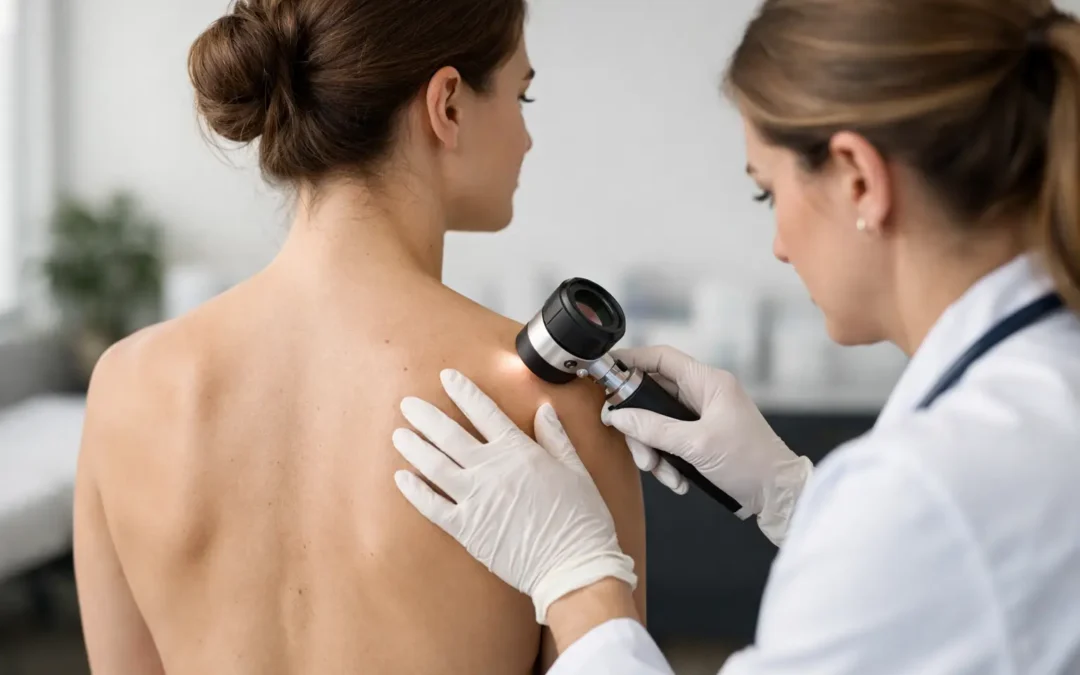
A changing mole is easy to put off when life is busy. The problem is that skin cancer often starts quietly, with a spot that does not look urgent at all. A full body skin exam is designed to catch those changes early, before they become harder to treat.
For many patients, the biggest barrier is not the exam itself. It is uncertainty about what happens during the visit, whether it is necessary, and how often it should be done. A clear understanding makes the decision easier.
What is a full body skin exam?
A full body skin exam is a head-to-toe evaluation of your skin, performed by a dermatology provider to check for suspicious moles, growths, lesions, and other changes. The goal is to identify skin cancer and precancerous spots as early as possible, while also noting other skin concerns that may need treatment or monitoring.
This exam is more thorough than checking one mole or one rash during a routine visit. Your provider looks at the entire skin surface, including areas you may not regularly see yourself, such as the scalp, back, behind the ears, and the bottoms of the feet. Depending on the findings, the visit may also include recommendations for monitoring, biopsy, or treatment.
Why this exam matters
Skin cancer is one of the most common cancers, and early detection makes a meaningful difference. When suspicious lesions are found early, treatment is often more straightforward and outcomes are generally better. That is especially true for melanoma, which can become serious if it is not identified promptly.
A full body skin exam also helps with conditions that are not cancerous but still deserve attention. Some patients come in worried about a new spot and learn it is harmless. Others mention a rough patch, persistent redness, or a lesion that bleeds occasionally and discover it needs treatment. The exam creates a baseline for your skin and helps separate normal variation from changes that should not be ignored.
Who should schedule a full body skin exam?
Not every patient has the same risk level, so screening frequency depends on personal history and clinical judgment. Still, a full body skin exam is a smart preventive step for many adults, particularly those with risk factors.
You may benefit from regular skin exams if you have a personal or family history of skin cancer, many moles, atypical moles, fair skin, a history of blistering sunburns, or significant lifetime sun exposure. Tanning bed use also raises concern, as do lesions that have changed in size, color, shape, or behavior.
Patients sometimes assume screening is only for older adults, but that is not always the case. Younger adults with high sun exposure, a strong family history, or unusual moles may also need routine surveillance. On the other hand, if you have no major risk factors, your provider may recommend exams on a less frequent schedule. It depends on your skin, your history, and what is found during evaluation.
What happens during the appointment?
A full body skin exam is usually simple, efficient, and focused. You will typically be asked about your medical history, any personal or family history of skin cancer, and any spots that are new, changing, itchy, painful, or bleeding. If you have noticed a specific lesion, point it out even if it seems minor.
During the exam, the provider examines your skin from head to toe. You may wear a gown so the skin can be evaluated carefully and respectfully. The visit is clinical and routine, and dermatology teams work to make patients feel comfortable throughout the process.
Your provider may use a dermatoscope, a handheld device that helps magnify and illuminate skin lesions. This allows for a closer look at pigment patterns and structures that are not obvious to the naked eye. In many cases, spots can be identified as benign during the visit. If an area looks concerning, your provider may recommend monitoring it, photographing it for comparison, or performing a biopsy.
Will every spot need a biopsy?
No. Many growths, moles, and age-related skin changes are benign and do not require a biopsy. Experienced dermatology providers are trained to distinguish common harmless lesions from those that need further evaluation.
That said, not every suspicious lesion can be diagnosed by appearance alone. If a spot has features that raise concern, a biopsy may be the safest next step. This is a quick in-office procedure in which a small sample, or sometimes the entire lesion, is removed and sent for pathology review. While hearing the word biopsy can feel stressful, it is often the most direct way to get a clear answer.
How to prepare for a full body skin exam
Preparation is straightforward, but a few small steps can help make the visit more efficient. It is helpful to remove nail polish if you can, since pigment can sometimes appear under the nails. Avoid heavy makeup if there is concern about facial lesions, and leave hair loose if possible so the scalp can be examined more easily.
If you have photos of a spot from a few months ago, bring them. Changes over time can be very useful. It also helps to make a note of lesions that itch, bleed, crust, or seem different from your other moles.
Many patients wonder whether they should shave or do anything special beforehand. In most cases, no special preparation is needed beyond basic hygiene and being ready for a complete skin check.
What dermatologists look for
During a full body skin exam, providers look for more than just dark moles. They evaluate pigment, border irregularity, asymmetry, texture, healing patterns, and lesions that stand out from the rest of your skin.
You may hear about the ABCDEs of melanoma: asymmetry, border irregularity, color variation, diameter, and evolving change. Those are helpful warning signs, but they are not the whole picture. Some skin cancers are pink, scaly, pearly, or persistently irritated rather than dark. Basal cell carcinoma and squamous cell carcinoma can appear very different from melanoma, which is why a professional exam matters.
Dermatologists also pay attention to what is called the ugly duckling sign. This refers to a spot that looks different from your other moles. Even if it does not match every textbook warning sign, a lesion that stands out deserves attention.
How often should you get checked?
There is no single screening schedule that fits every patient. Some people should be seen annually, while others may need more frequent follow-up because of prior skin cancer, multiple atypical moles, immune suppression, or a strong family history.
If your skin exam is normal and your risk is average, your provider may recommend routine checks at longer intervals or advise you to return sooner only if you notice a change. If you have had skin cancer before, regular surveillance is often a more important part of long-term care.
Between visits, self-checks still matter. A professional exam does not replace paying attention to your own skin. If something changes, do not wait for your next scheduled appointment to bring it up.
The value of specialist evaluation
A full body skin exam is most useful when it is part of a broader dermatology care plan. If a lesion needs biopsy, treatment, surgery, or long-term monitoring, having access to experienced medical and surgical dermatology can make the process more efficient.
That is especially important for patients with a history of skin cancer or lesions in cosmetically sensitive areas. Diagnosis is only one part of care. Treatment planning, pathology coordination, follow-up, and preventive guidance all matter.
For patients and families across North Georgia, Goodman Dermatology provides full body skin exams along with advanced medical, surgical, and skin cancer services across multiple convenient locations. That combination of specialist-level care and local access can make it easier to stay consistent with screening.
When to schedule sooner rather than later
Some changes should not wait. If you have a mole or spot that is growing, bleeding, crusting, painful, rapidly changing, or simply looks different from the rest, it is reasonable to schedule an exam promptly. The same is true for a sore that does not heal or a rough patch that persists despite moisturizer or time.
Many concerning lesions turn out to be treatable and manageable, especially when addressed early. Waiting does not make a suspicious spot easier to evaluate. If something on your skin has your attention, that is often reason enough to have it checked.
A full body skin exam is a practical step toward protecting your health, and it does not need to feel complicated. A careful exam, the right follow-up, and a provider who takes your concerns seriously can give you both answers and peace of mind.